
 Go back to overview
How Much Should the Shoulder Move After Rotator Cuff Repair?
How common are rotator cuff tears?
The rotator cuff is the group of four tendons that hold the shoulder in place and allow overhead activity. Tears are common and become more frequent with age.
How the tear is repaired
The torn tendon is freed, drawn back to its attachment on the bone, and secured with suture anchors — the single-row, inverted mattress technique used in this study
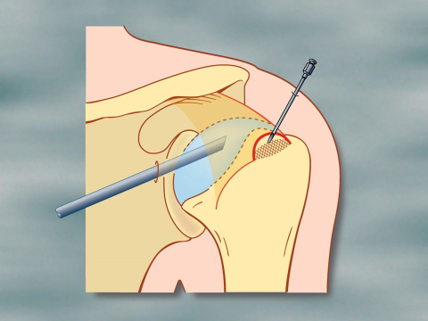
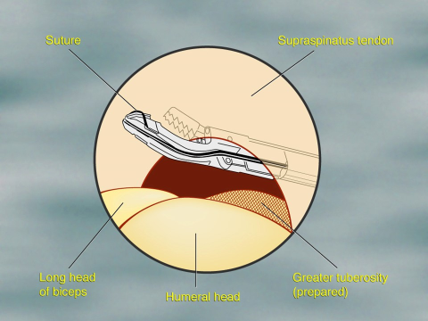
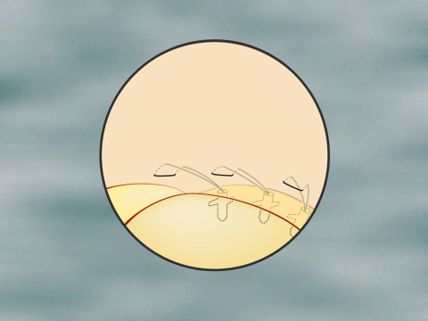
Steps in arthroscopic rotator cuff repair: the tendon is mobilised and reattached to its footprint on the bone with suture anchors.
Post-Surgery Rehab
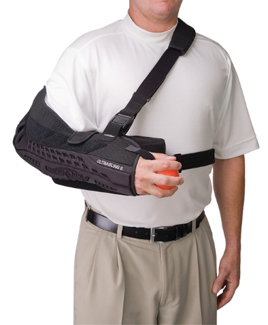
After surgery the shoulder is placed in a sling with a small abduction pillow. Gentle range of motion exercises are initiated.
Retear
Retear is the most common complication after rotator cuff repair. We often assume patients should regain shoulder movement quickly — but movement is exactly what loads a healing tendon. Our new study asked a simple question: how much early motion is safe?
What we found
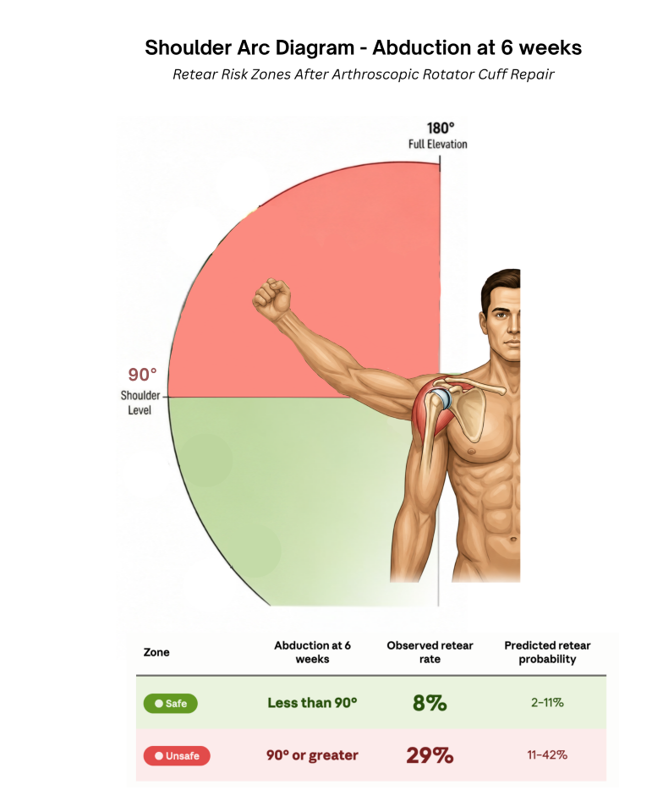
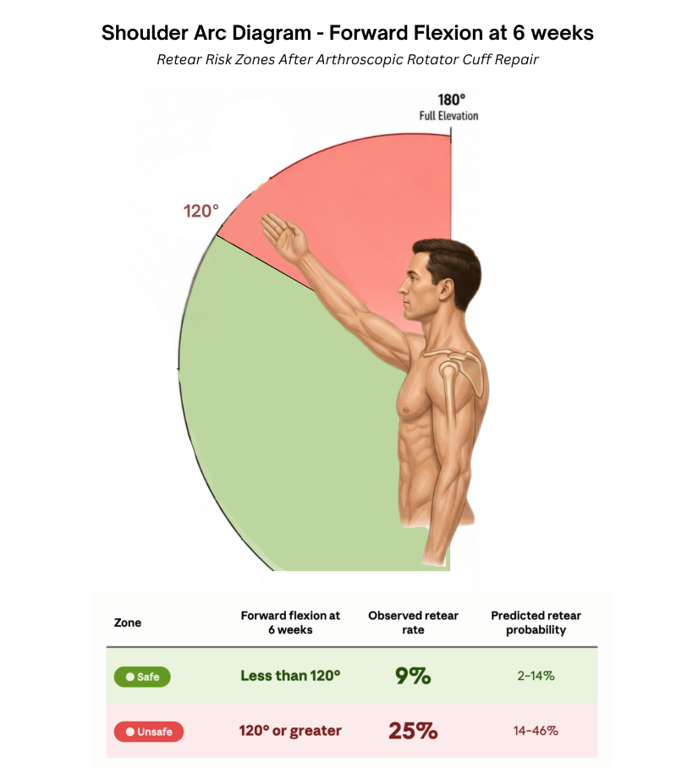
In 156 patients undergoing arthroscopic rotator cuff repair, less shoulder movement at six weeks meant better healing. Each extra degree of passive forward flexion or abduction at six weeks raised the odds of retear/failure to heal.
- Abduction under 90° or forward flexion under 120° at 6 weeks: retear rate 7%.
- Above those thresholds: retear rate 25% — about three times higher.
Patients who reported a stiffer, more painful shoulder at six weeks also had lower retear rates. A stiff shoulder early on is often a sign the repair is healing well.
Safe and unsafe zones
Why stiffness may protect the repair
Patients with less early movement reported more pain with activity, at rest and during sleep. The likely explanation: more pain reflects a stronger healing response, and these patients naturally move and stress the repair less. Comfort too soon can tempt patients to overuse the arm before the tendon has healed.
What this means for GPs
A stiff shoulder at six weeks after cuff repair is usually reassuring, not a sign of failed rehab. Reduced early motion sits in the safe zone; a shoulder already moving freely beyond these thresholds warrants a more protective approach. Use these zones as a simple checkpoint and to reassure anxious patients that recovery of full movement comes later — the tendon heals first.
Key takeaway
Less early shoulder movement is linked to better healing after rotator cuff repair. In the first 6 weeks after rotator cuff repair surgery keep forward flexion below 120° and abduction below 90°.
Prepared with the assistance of Daniel Looi, Antonette (Yama) Bilog, Mina Shenouda and Matthew Khalaf
Professor George A. C. Murrell is an Orthopaedic Surgeon who specialises in shoulder surgery, with interests in arthroscopic methods to repair and restore damaged ligaments and tendons.
About HealthShare
HealthShare is a leading digital health company. We are dedicated to improving health outcomes for patients through our innovative products for GPs, Specialists, Health organisations and more. To see how we can help you, visit HealthShare.